
Macromill and Yokohama City University announce establishment of a joint data science lab
Accelerating R&D in data science and talent development in Japan
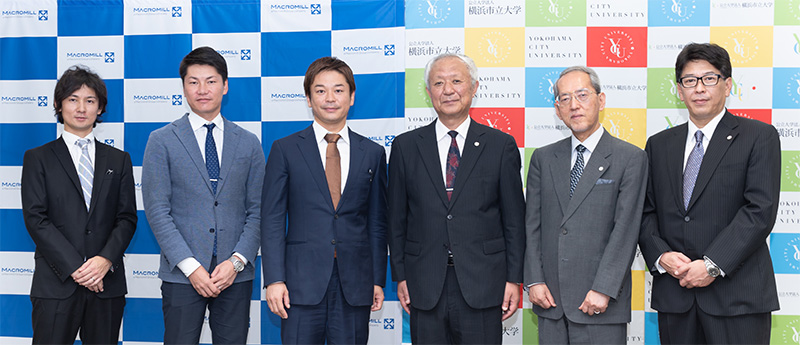
Global market research company Macromill, Inc. (Macromill) and The Public University Corporation Yokohama City University (Yokohama City University) have announced that they will open the “Yokohama City University/Macromill Data Science Joint Lab.” (hereinafter referred to as “the Joint Lab”) in April 2019.Located at Macromill’s headquarters in Tokyo, the Joint Lab aims to expand marketing business in a mid- to long-term collaboration with an academic and research perspective in the areas of data science, as well as to develop human resources with a research mind and a business view.
The Joint Lab project is a part of the “Basic Agreement Regarding Industry-Academia Collaboration”, which Macromill and Yokohama City University concluded in July 2018.
1. Background
There are increasing demands for marketing research especially in the area of integrated analysis of various types of data such as consumer insights and multi-country surveys. As Macromill already conducts marketing research internationally, and Yokohama City University’s School of Data Science is unique in the Tokyo metropolitan area, we agreed to work together to create new business opportunities and social value in marketing research through various activities in the Joint Lab.
2. Objective
The Joint Lab will focus primarily on academic research themes, through which Research & Development (R&D) and Talent Development in data science and marketing business are expected to benefit. The theoretical achievements in data science will be verified using Macromill’s rich data sets. All of the outcomes of the Lab will be made available to the public through conference presentations, journal articles and open seminars.
Macromill and Yokohama City University aim to accelerate the synergy of people and physical assets, promote utilization of enormous volumes of big data owned by the corporations, and create new values for our society including activation/enabling of marketing activities.
3. Outline
■ Name
YCU/Macromill Data Science Joint Lab.

■ Location
Macromill, Inc. Office
■ Team
Post-doctoral researchers (new position, one researcher per theme), guest researchers from Macromill, associated faculty
members from Yokohama City University, and administrative assistant.
■ Activity
【R&D】
- (1) Joint research based on business needs
- (2) Publishing results to society through conferences, journal articles and open seminars
【Talent Development】
- (3) Providing data as educational/research materials
- (4) Talent exchange
■ Period
Initially, four years from April 2019
■ Main Study Themes*Please refer to attached formore details
-
A. Statistical analysis of missing data
Trying to develop statistical methodologies to supplement missing data, which cannot be completed due to physical factors/cost.
-
B. Study of Multi-source Data Equivalent Methods
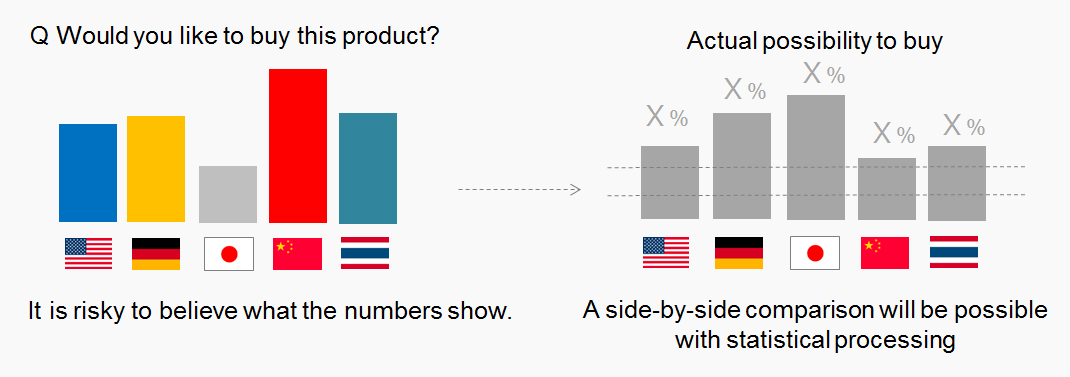
Trying to expand potential of global marketing by adjusting multi-country survey reports based on statistical theory, which researchers used to interpret subjectively with “gut feel”.
4. Comment From The Representative
Toru Sasaki, Representative Executive Officer, Japan Operation, Macromill, Inc.
“Globalization and digitalization is changing Japanese corporations’ marketing environment as well as the requirements for research companies. I believe the Joint Lab will integrate each organization’s know-how to expand the potential of marketing research business with programs that promote practical usage of corporations’ enormous big data assets. I also believe our effort will contribute to develop and grow the industry.”
Yoshiyuki Futami, CEO and Chairperson of the Board of Trustees, The Public University Corporation Yokohama City University
“For academia, it is essential that we collaborate with business corporations if we are to find new insights in data science and realize them in actions. From an industry perspective, corporations want to understand society’s needs better, and that is why we decided to work together to create innovation. I believe this collaboration will bring together academic research methodologies with the speed, technologies and expertise that business works at to enable us to synergize research and talent development. We look forward to working together to help solve society’s issues.”
Media Inquiries
Morita, Communication Design Division, Macromill, Inc.TEL: 03-6716-0707 Contact
TEL:045-787-2414 E-mail:koho@yokohama-cu.ac.jp
You can download the PDF version from the link below.
Reference: Details of Study Theme
■ Statistical Analysis of Missing Data
<Current Challenges>
Despite the enormous volumes of diversified data that are available on consumers today, we still struggle to identify sufficient insights for academia and industry.
Single Source Data*1is in high demand, but it is rare to find complete data sets and therefore it is often insufficient for analysis. If we have solutions with statistical rigor, we will be able to use them to analyze data efficiently even with missing data.
<Example of “Missing” Data>
1. Inevitable missing data and bias
EX) It is impossible to compare “Person A who didn’t see the ad and Person A who saw the ad” at the same time. However, comparing “Person A before seeing the ad and Person A after seeing the ad” may cause bias unless other factors are excluded.
2. ”Non-Response” generates missing data and bias
EX)Many respondents are unwilling to answer questions with regard to privacy. Analysts often must deal with missing data as a result. Excluding missing data results in bias, thus it is difficult to capture the entire sample group with high accuracy.
<Example of Study in Practice>
A major retailer will be able to estimate the purchase trend of a particular consumer in a competitor’s store or other category channel to allow them to develop more personalized store promotion customized to individual needs. Consumers will be able to find product information better suited to their likes/dislikes.
■ Multi-source Data Equivalent Methods
<Current Challenges>
Multi-country research is in high demand to help Japanese export businesses succeed. However, it is difficult to compare results because each country has different national characteristics and culture, thus different interpretation of evaluation index.
<Example of Study in Practice>
A Japanese global automotive manufacturer will be able to understand the brand image of its own and competitor’s brands in each country more accurately. This will improve each market’s brand marketing to drive higher revenue.